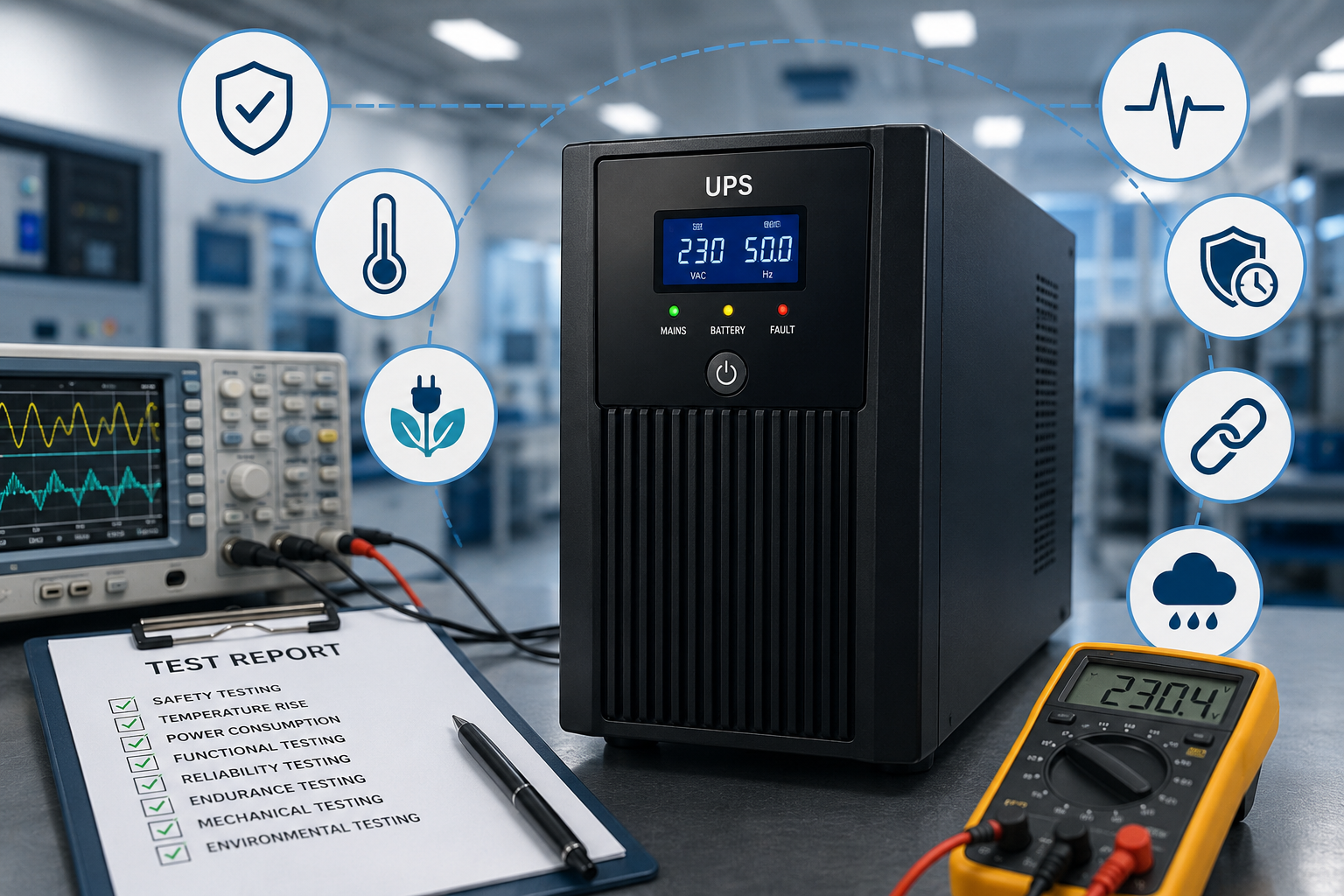
UPS Test Parameters: Ensuring Reliable Power Backup Performance
An Uninterruptible Power Supply (UPS) is a critical power protection device used in homes, offices, hospitals, data centers, telecom infrastructure, and industrial facilities. Since UPS systems are responsible for delivering uninterrupted power during outages and protecting sensitive electronic equipment, they must undergo comprehensive testing before reaching the market.
At Matrix Test Labs, we conduct extensive testing to verify that UPS systems comply with applicable BIS and international safety standards, ensuring safe operation, dependable performance, and long service life.
Below are the key test parameters evaluated during UPS testing.
1. Safety Testing
Safety testing ensures that the UPS does not pose electrical, fire, or mechanical hazards during normal operation or fault conditions.
Key Evaluations
- Electric shock protection
- Leakage current measurement
- Dielectric withstand (High Voltage Test)
- Insulation resistance
- Earthing continuity
- Protection against overheating
- Protection against fire hazards
Why It Matters
A properly tested UPS protects both users and connected equipment from electrical hazards while ensuring compliance with regulatory requirements.
2. Temperature Rise Test
Electronic components generate heat during operation. Excessive temperatures can reduce efficiency and shorten product life.
Parameters Checked
- Internal component temperature
- Transformer temperature
- Battery temperature
- Power semiconductor temperature
- Surface temperature
- Ventilation effectiveness
Purpose
The test confirms that temperatures remain within permissible limits under rated operating conditions without affecting performance or safety.
3. Power Consumption Test
Power consumption testing measures how efficiently the UPS utilizes electrical energy during different operating modes.
Evaluations Include
- Input power
- Output power
- Standby power consumption
- No-load power consumption
- Efficiency under various load conditions
- Power factor
Importance
Higher efficiency reduces energy costs, minimizes heat generation, and improves overall system performance.
4. Functional Testing
Functional testing verifies that every operational feature of the UPS performs as intended.
Functional Checks
- AC to battery changeover
- Battery to AC recovery
- Automatic voltage regulation (AVR)
- Overload protection
- Short-circuit protection
- Alarm indications
- Display functions
- Charging performance
- Output voltage regulation
- Backup time verification
Benefits
Functional testing ensures reliable performance during real-world power failures.
5. Reliability Testing
Reliability testing evaluates the UPS's ability to operate consistently over extended periods.
Test Parameters
- Continuous operation
- Multiple power interruption cycles
- Switching performance
- Battery charging cycles
- Component stability
- Failure rate assessment
Objective
To ensure the UPS delivers dependable performance throughout its expected service life.
6. Endurance Testing
Endurance testing subjects the UPS to prolonged operating conditions to verify durability.
Typical Evaluations
- Long-duration operation
- Continuous full-load performance
- Repeated battery discharge and recharge
- Thermal endurance
- Operational stability after extended use
Importance
This test helps identify wear-related failures before products reach customers.
7. Mechanical Testing
Mechanical tests ensure the UPS enclosure and components can withstand handling, transportation, and daily use.
Mechanical Evaluations
- Enclosure strength
- Impact resistance
- Stability test
- Mounting integrity
- Connector durability
- Switch operation
- Cable strain relief
- Mechanical construction inspection
Purpose
Mechanical testing enhances product durability and minimizes failures caused by physical stress.
8. Environmental Testing
UPS systems are often installed in challenging environments. Environmental testing verifies reliable operation under varying conditions.
Environmental Conditions Tested
- High temperature
- Low temperature
- Humidity
- Thermal cycling
- Dust resistance
- Vibration
- Transportation simulation
- Storage conditions
Why It Matters
Environmental testing confirms that the UPS maintains reliable performance across diverse operating environments.
Why Comprehensive UPS Testing is Important
Comprehensive testing helps manufacturers:
- Ensure electrical safety
- Meet BIS and international compliance requirements
- Improve product reliability
- Enhance energy efficiency
- Reduce warranty claims
- Increase customer confidence
- Validate long-term product performance
Testing also helps identify potential design issues before products enter commercial production.
UPS Testing at Matrix Test Labs
Matrix Test Labs offers professional UPS testing services using advanced laboratory equipment and experienced engineers. Our testing capabilities support manufacturers, importers, and brands in achieving product compliance while maintaining high standards of safety and performance.
Our comprehensive testing includes:
- Safety Testing
- Temperature Rise Testing
- Power Consumption Testing
- Functional Testing
- Reliability Testing
- Endurance Testing
- Mechanical Testing
- Environmental Testing
With a focus on quality, precision, and regulatory compliance, Matrix Test Labs helps ensure that every UPS system performs safely and reliably under real-world operating conditions.
Conclusion
A UPS is only as reliable as the testing behind it. Comprehensive evaluation of safety, thermal performance, power efficiency, functionality, reliability, mechanical strength, and environmental resistance ensures dependable operation when uninterrupted power is needed most.
Partnering with Matrix Test Labs provides manufacturers with accurate, standards-compliant testing that supports product quality, regulatory approval, and customer trust.